

















The phrase sustainable fashion brands has been worn so thin that it now means almost nothing. Every label has a page about it. Almost none of them are lying, exactly - they are simply telling you the most flattering true thing they can find. And a boutique that repeats those claims without checking them is just a louder version of the same problem.
So rather than write you a list of brands with green credentials, we want to be straight about how we actually think when a label comes across the desk at Tuchuzy - what we can verify, what we cannot, and what we have concluded is the only claim that never gets exaggerated.
The only claim that cannot be gamed
Here it is: a garment you wear two hundred times is more sustainable than a garment you wear four times, regardless of what either was made from.
This is unglamorous and it is not marketable, which is precisely why nobody builds a campaign around it. But it is the truth that survives every argument. Fibre content, water use, certification schemes - all of it matters, and all of it is dwarfed by the simple question of whether the thing gets worn. A conventionally made jean worn for a decade beats an organic cotton jean worn for a season, and it is not close.
Which means the first question we ask about any label is not about their supply chain. It is about their construction. Are the seams going to hold. Is the fabric going to pill in three washes. Is the cut good enough that you will still want it in four years, or is it a shape that will date the moment the trend cycle turns. Those questions are answerable by hand, in a showroom, and they are the ones that actually determine a garment's footprint.
Reworked denim, and why RE/DONE is different
There is one model in our shop where the environmental logic is structural rather than aspirational, and that is RE/DONE. The label was built on a genuinely simple premise: take existing vintage Levi's denim, take it apart, and rebuild it into a modern fit. The raw material already exists. Nothing new is being grown, spun or dyed to make it.
That is not a marketing position, it is the manufacturing method - which is a meaningful distinction. Pieces like the Re/Done The Californian Jean or the Re/done A Frame Short Sonoma Indigo are, quite literally, denim that has already lived one life. The Re/done x Hanes V Cut Ribbed Tank Vintage Ivory extends the same instinct into jersey, reissuing a shape rather than inventing one.
Reworked denim also happens to wear beautifully, because vintage Levi's cotton was woven to a standard modern fast-fashion denim does not attempt. The sustainability and the quality are the same fact, seen from two angles. That is the version of the argument we trust.
Natural fibres: real, but not a free pass
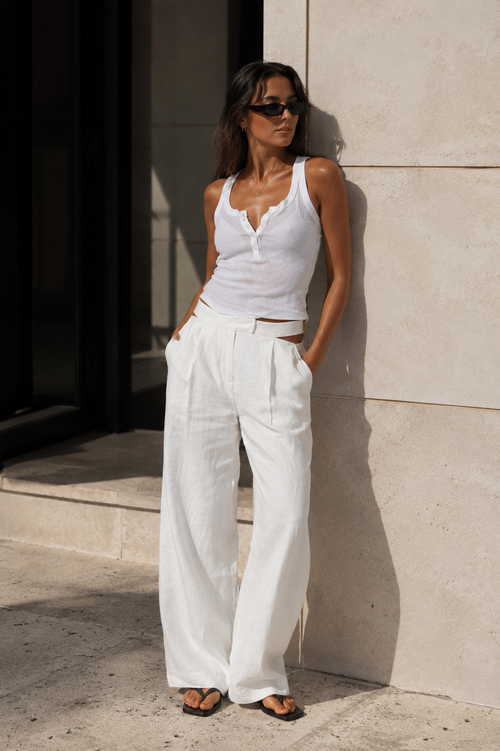
Linen has become a shorthand for conscious dressing, and there is something to it. Flax is a hardy crop, linen is a durable fibre, and a linen garment that is cared for properly will outlast almost anything else in the wardrobe. The Chosen Linen Raw Low Rise Pants and the Chosen Tailored Micro Linen Shorts are pieces we expect to see people wearing for years, and the full linen edit is built on that expectation.
But linen is not automatically virtuous. A badly cut linen dress that loses its shape after two summers is not a sustainable purchase in any meaningful sense - it is a natural-fibre landfill item. The fibre buys you potential. The construction decides whether you get to use it.
Same with cotton, which is the most-repeated word in the entire conscious fashion conversation and the least informative. Cotton can be grown well or badly, spun well or badly, and made into something that lasts or something that does not. The word itself tells you almost nothing.
What we will not tell you
We will not tell you that a label is ethical because its website says so. We stock labels across our full range of designer labels whose environmental practices we know well, and others where our honest position is that we like the clothes, we trust the construction, and we have not independently audited their factories - because we have not, and pretending otherwise would be exactly the behaviour this article is complaining about.
What we can tell you is what we look at. Fabric weight and hand-feel. How a seam is finished on the inside, where nobody is meant to look. Whether the label has been consistent for a decade or arrived last season with a story. Whether the piece is a shape that will still make sense in 2030. Those are the things a boutique with thirty years on the same street is genuinely qualified to assess.
The part that is your job, not ours
The most sustainable wardrobe in Bondi belongs to a woman who buys about six things a year and wears all of them constantly. She did not achieve that by reading brand manifestos. She achieved it by being extremely specific about what she actually needs.
Care matters more than most people admit. Wash less, and cooler. Air things rather than laundering them by reflex. Dry linen and cotton flat and out of direct sun. Repair a seam rather than replacing a garment - most good pieces need one small intervention in their life and then continue for another five years. A pair like the Re/Done The Strutter Comfort Stretch Sonoma Indigo, or anything from the womens jeans edit, that gets hemmed, patched once and worn for a decade is a better environmental outcome than anything you can buy your way into.
And buy for the life you have. This is the same argument we make about capsule dressing, and it is not a coincidence. Overbuying is the environmental problem. Everything else is a rounding error.
Come and touch the fabric
All of this is much easier to judge in person than online, which is an inconvenient thing for an e-commerce page to admit. If you are in Sydney, visit us in Bondi Beach and put your hands on the cloth - it will tell you more in ten seconds than any product description can. If you are elsewhere, Tuchuzy ships worldwide, including across Australia and to the United States, and we are very happy to answer specific questions about how a piece is made before you commit to it.
Your questions answered
Which sustainable fashion brands do you stock? RE/DONE is the clearest case, because its entire model is rebuilding existing vintage denim rather than producing new cloth. Beyond that, we stock a number of labels working with natural fibres and small-run production, and we are happy to talk through any specific brand rather than make a blanket claim on their behalf.
Is linen genuinely more sustainable than cotton? Flax generally requires less water and fewer inputs than conventional cotton, and linen is a durable fibre. But the garment still has to be well made and well worn. Fibre alone is not the whole answer.
Is buying second-hand always better? Extending the life of an existing garment is almost always the lowest-impact option, yes. Reworked denim is a version of that logic applied at production scale.
How do I spot greenwashing? Look for specifics. A brand that names a fibre, a percentage, a factory or a process is telling you something. A brand that uses the words conscious, mindful or eco without a single number attached is telling you nothing.
What is the single most useful change I can make? Buy less, choose better, and wash things half as often as you currently do. It is not a satisfying answer, but it is the correct one.